Night’s Watch vows
A Clash of KingsThe Night’s Watch vows are the binding rule by which a man enters and defines his life in the Night’s Watch. They require him to abandon ordinary claims to family, property, marriage, children, crowns, and glory, and to replace them with perpetual service at the Wall. In the oath’s final image, the sworn brother becomes both weapon and sentinel: a sword in darkness, a watcher on the walls, and a shield for the realms of men.
Form and Meaning
The vows are remembered as beginning with the stark announcement, “Night gathers, and now my watch begins.” Their language turns a personal decision into an enduring condition. The watch does not end with a campaign, a commander’s death, or the easing of immediate danger; it lasts until the speaker’s own death. The oath therefore defines time as service without retirement and makes death the only natural release from its obligations.
The renunciations are equally precise. The speaker pledges to take no wife, hold no lands, father no children, wear no crowns, and win no glory. These prohibitions separate the Night’s Watch from the ambitions that animate the kingdoms. A sworn brother cannot pursue dynastic inheritance, establish a household, or convert military service into personal fame without violating the identity he has assumed. The vow is thus both a promise of protection and a deliberate stripping away of status, possession, and posterity.
The Ceremony of Repetition
The vows acquire their full force in the scene where Jon Snow repeats them with Qhorin Halfhand beside a failing fire. Qhorin first asks whether Jon remembers the words, and Jon answers that they are not words a man is likely to forget: once said, they can never be unsaid, and they change a man’s life forever. This description presents the oath as an irreversible act of speech rather than a ceremonial formula that can be casually abandoned.
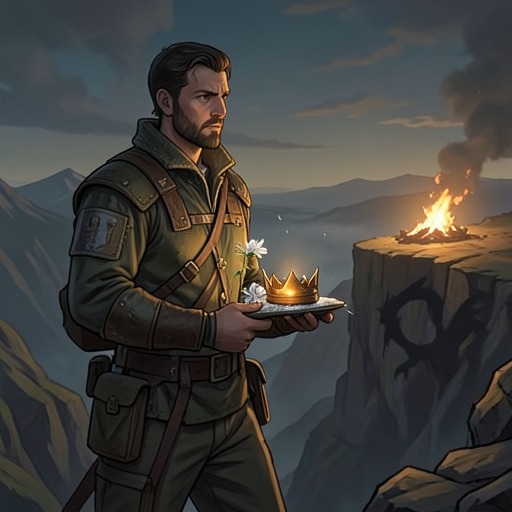
Qhorin and Jon recite the vows together beneath the rising moon while Ghost listens and the mountains bear witness. The setting enlarges the promise beyond the two men. Their joined voices create a moment of collective continuity, linking an individual recruit to the ancient institution he serves, while the surrounding wilderness and the Wall’s presence make the oath seem answerable to forces larger than any single commander.
The ceremony is shadowed by exhaustion and approaching death. The garrons are nearly spent, Qhorin’s mount is not expected to last another day, and Jon prays for the strength to die bravely when his own hour comes. The vows therefore do not offer safety; they give meaning to danger. Qhorin’s warning that if the Wall should ever fall, all the fires will go out binds the personal watch to the survival of the larger human world.
Duty Above Ordinary Law
The vows also establish a distinctive jurisdiction. When Jon Snow objects to Craster’s brutality, Jeor Mormont reminds him that Craster has sworn the Night’s Watch no vows and is subject to neither its laws nor its authority. The lesson is not that Craster’s conduct is acceptable, but that the Night’s Watch cannot set the world right wherever injustice appears. Its sworn duty is narrower and more demanding: it has other wars to fight.
This limitation places the vows among several competing systems of obligation. Kingdoms have their rulers and laws, families have their loyalties, religions have their sacred commands, and local powers preserve their own customs. The Night’s Watch vows do not erase those systems; they remove the sworn brother from ordinary participation in them and give the Watch authority over him instead. The resulting discipline depends on the clarity of the promise and on the brother’s acceptance that moral concern alone does not grant him unlimited power to intervene.
Conflicting Vows and Political Promises
The vows become especially revealing when contrasted with the obligations of rulers and knights. Jaime Lannister explains that he was required to defend and obey the king, keep the king’s secrets, and give his life for him, while also being expected to obey his father, love his sister, protect the innocent, defend the weak, respect the gods, and obey the laws. He treats these demands as mutually impossible, arguing that every choice may forsake one vow for another.
The Night’s Watch vows respond to that instability through concentration rather than multiplication. They do not promise to satisfy every role at once. Instead, they replace competing political, familial, and religious claims with one institutional allegiance: life and honor pledged to the Night’s Watch for this night and all the nights to come. Their severity is also their clarity, though the clarity does not make obedience easy when the sworn brother faces fear, injustice, or divided loyalties.
Other scenes show how easily authority can be asserted through formal language without possessing the same moral force. Aeron Greyjoy performs a rebaptism of Theon Greyjoy with seawater, commanding him to be born again from the sea and invoking salt, stone, and steel. Theon answers with the repeated maxim “What is dead may never die,” a ritual promise of renewal within the culture of the Iron Islands. Likewise, titles and commands in the wider political world shift according to power: Renly Baratheon calls Stannis Baratheon “King Stannis,” while Stannis refuses to yield the title. Against such unstable claims, the Night’s Watch oath derives its authority from duration, renunciation, and repeated communal practice rather than from a crown or immediate political recognition.
Discipline, Surveillance, and the Cost of Service
The practical world surrounding the vows is marked by surveillance and enforced obedience. When Arya Stark is disguised as the orphan boy Arry, Yoren warns her that many among the recruits would betray her for a pardon and silver, while others might first assault her. He orders her to keep to herself and to meet even her bodily needs alone in the woods. Although Arya is not yet a sworn brother, the episode reveals the harsh social discipline of the road to the Wall: survival depends on concealment, obedience, and separation from the identity she has left behind.
The Watch’s institutional authority is likewise contrasted with the crown’s coercive power. Tyrion Lannister removes Janos Slynt from command and sends him toward the Night’s Watch, while Slynt protests that he is a royal favorite and boasts of allies among Joffrey Baratheon, Petyr Baelish, and the queen. His arrival is answered not by argument but by the appearance of Ser Jacelyn Bywater and six gold cloaks, who take him into custody. Service at the Wall functions here as a political punishment, yet the vows themselves transform that imposed destination into a distinct moral order once a man takes them.
The oath’s significance therefore rests on a severe exchange. The sworn brother gains a defined purpose and a place within a collective defense, but loses the ordinary future promised by family, inheritance, and public honor. Its words are strongest at the point where those losses become irreversible: the recruit is no longer merely choosing a post, but accepting a life whose final measure is whether he remains the sword in the darkness, the fire against the cold, and the shield guarding the realms of men.